Mary Layton Alms Houses
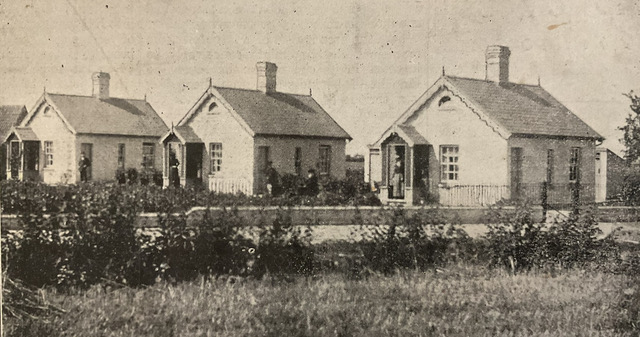
The Mary Layton Almshouses are a group of 3 single-bedroom bungalows set at the western end of Little Wilbraham’s High Street as it divides into Fen Road and Mill Road. The benefactor of the almshouses was one Frederick Layton who was born in May 1827 in a house that previously stood on the site, the only son of John & Mary. In 1836 the Laytons moved to Great Wilbraham where John Layton established a small butcher’s shop and taught Frederick his trade. In 1842 John and Frederick emigrated to the United States eventually arriving in Milwaukee, Wisconsin the following year. Mary Layton remained in Great Wilbraham before joining them in 1847.
Although the early years were spent as farmers near the town of Raymond, Wisconsin, father and son returned to the butchery trade in nearby Milwaukee and here they prospered. The business grew quickly and was helped by their supplying meat to the Union Army during the American civil war (1861 – 1865). Following the cessation of the war, along with a partner, they absorbed a number of railway companies so as to further improve the distribution of their meat products, particularly pork. This expansion includes significant exports to Britain and Germany. The Laytons also built the first hotel in Milwaukee in 1849 and it is still standing.
As his fortune grew Frederick was able to further his interest in art to the point that he was wealthy enough in 1888 to donate to Milwaukee the first art gallery in the city the Layton Art Gallery. Designed by the London architect George Audsley, the building facade bears a striking resemblance to the Fitzwilliam Museum in Cambridge and the Walker Art Gallery in Liverpool. The Layton Art Gallery was demolished in 1957 and became a parking lot while much of the collection was sold. However, Frederick Laytons’ legacy is still seen in the Layton Art Collection now housed in the Milwaukee Art Museum.
Following his retirement from business in 1900, Frederick revisited his birthplace the following year and bought the house and land where he was born. The previous dwelling was demolished and the 3 almshouses on the site today were opened in 1901 and named in memory of his mother.
The Charity’s Deed specifies that the occupants should be “Such persons being agricultural labourers and inhabitants at the time of election of the said parish of Little Wilbraham or being and having up to the time of election remained the widows of agricultural labourers who were at the time of their death inhabitants of the parish”.
As well as donating the land and buildings to the first Trustees a sum of £1,500 was also invested to pay the administration costs of the charity in addition to the care and maintenance costs of the properties. The first Chair of the Trustees was the Rector Mr F.C.Marshall (1887 – 1903) and the first gardener Mr Thomas Brand who was paid 4 shillings for two days work. Should there be anything left over the tenants were to be paid a sum not exceeding 6 shillings every Saturday.
The cottages were improved and extended around 1976 creating an internal toilet/bathroom and installing central heating. Since then there has been a steady program of renewal with a complete refurbishment of cottage 2 in 2025.
Times have changed somewhat since 1901. Agriculture was the very basis of Little Wilbraham at the time and probably had been since the village came into existence. Although obviously blessed with foresight there is no way Frederick Layton could have envisaged the farm machinery available today and that thousands of acres could be managed by one man in a tractor. The Trustees would be unable to appoint any tenants to the cottages were they to stick absolutely to the Deed so a fairly liberal interpretation is employed whenever a tenancy becomes available although preference is still given to those applicants who have lived within the parish or have a close association with it. Moreover, whereas the original occupants of the cottages lived rent-free there is now a monthly maintenance charge and the gift of 6 shillings per week to be paid on a Saturday is definitely a thing of the past.
It is obvious that Frederick Layton was a very successful businessman and this allowed him to indulge his twin passions of art and philanthropy. As well as establishing the art gallery to which he donated over 200 exhibits he also had built the Layton Home for Incurables in the grounds of the Milwaukee hospital, the Milwaukee School of Arts as well as donating to significant numbers of smaller charities. Frederick and his wife Elizabeth, for all their wealth, were very private people and lived very modestly in the same house for 54 years. They had no children. Elizabeth died in 1910 with Frederick passing away on 16 August 1919. Both are buried in Milwaukee.
This is a remarkable story starting with a family engaged in a very modest trade in a small Cambridgeshire village and ending with an international entrepreneur and philanthropist leaving a legacy for future generations to explore and enjoy, in two countries.
This year, 2026, will be the 125th anniversary of the opening of the almshouses and the charity trustees together with the Little Wilbraham and Six Mile Bottom Parish Council, will be holding a number of events to celebrate the Layton family legacy.
Public Talk – Friday 19th June 6:30pm – Memorial Hall Great Wilbraham – “the Layton Legacy”
1900’s Party – Saturday 27th June – Little Wilbraham – “themed 1900s Village Celebration”
All welcome and if you would like any further information, please contact the Charity Secretary.
Email : marylaytontrust@outlook.com
Link to Mary Layton Alms Houses Public trust files
Mary Layton Almshouse Charity